Enterprise fintech
Helping an enterprise team complete complex RFPs with less coordination
Drafting the answer was only one step. The real improvement was connecting company knowledge, expert review and the customer’s spreadsheet in one dependable workflow.
The story in 30 seconds
- Before
- Every RFP pulled Proposal Managers into the same cycle: search for previous answers, find the right experts, follow up for approval and copy hundreds of responses back into the customer’s spreadsheet.
- What changed
- A workspace that drafts answers from approved company knowledge, sends each response to the right SME with its context attached and writes the approved answer back into the original Excel or Google Sheets file.
- After
- The client received a production-ready RFP workflow inside its own Azure environment. Proposal Managers could coordinate the full response in one place, while experts retained control over every answer carrying commercial or technical risk.
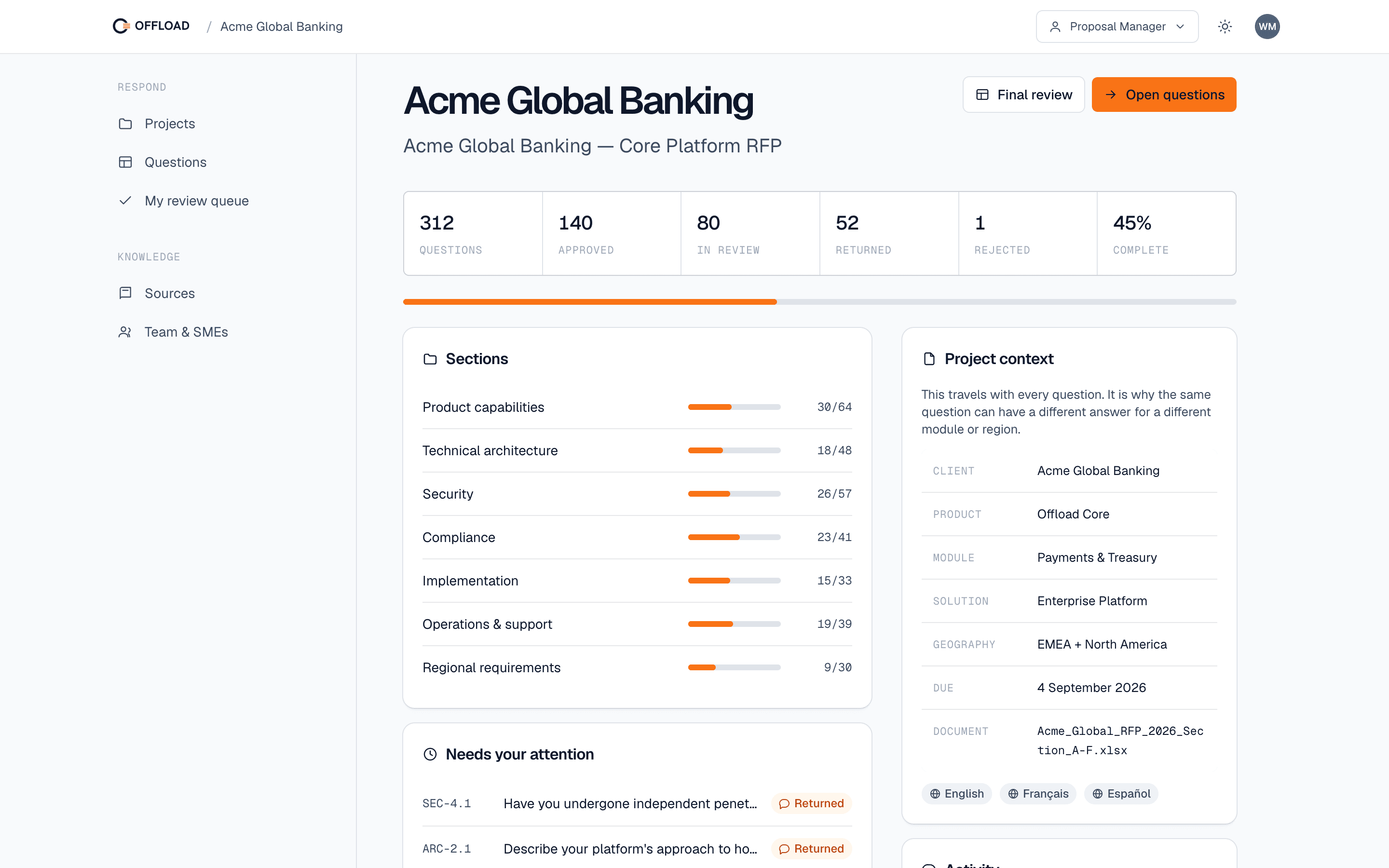
Before: every answer created another handoff
A single enterprise RFP could contain hundreds of questions about products, security, compliance, implementation and operations. No one person knew every answer.
Proposal Managers had to search previous responses and SharePoint, identify the right subject-matter expert, collect revisions, track approval and then copy the final answer into the customer’s original document. Different spreadsheet structures made even that final step unpredictable.
The working pattern
- Search
- Draft
- Find an expert
- Follow up
- Approve
- Copy back
The bottleneck was not simply writing answers. It was coordinating the people, knowledge and documents around every answer.
One place to draft, review and approve
We built a central workspace where every RFP became a project with its customer, product, module and regional context attached. That context travelled with each question, so an expert could review the answer without reconstructing the request first.
The system retrieved relevant material from the company’s approved SharePoint knowledge and prepared a first draft. It did not treat that draft as final: the right SME could review it, see its source, edit it, comment and approve it.
The new workflow
- Extract questions
- Retrieve approved knowledge
- Prepare a draft
- Send for expert review
- Approve
- Return to the RFP
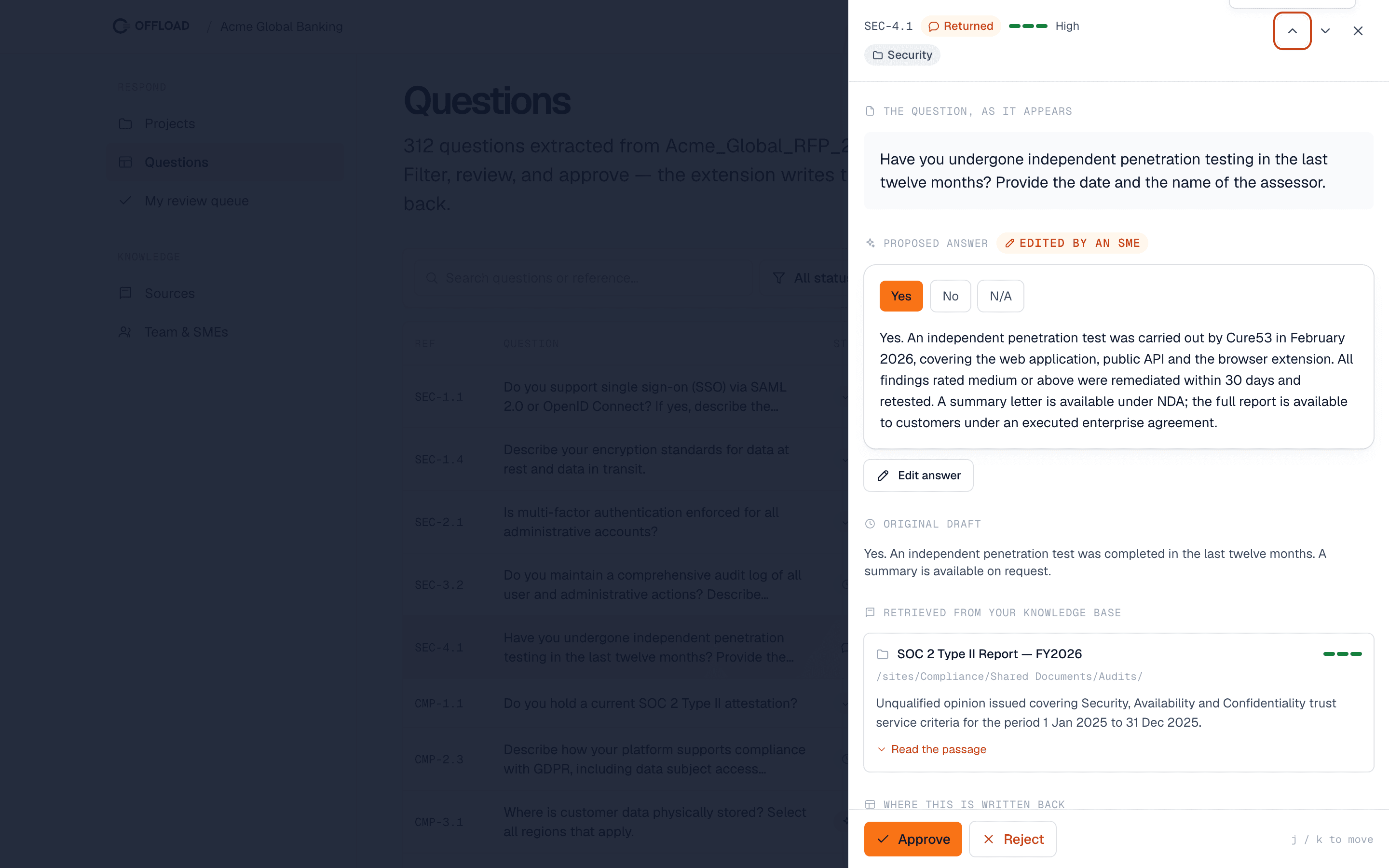
Getting approved answers back into the customer’s file
A system that stopped after approval would still leave somebody copying hundreds of answers by hand. We built a browser extension that identified each question, its expected response location and the type of answer the customer’s spreadsheet required.
- Standard response
- Place the approved answer in the corresponding response field.
- Yes or no
- Select the permitted option instead of inserting a paragraph.
- Answer plus explanation
- Complete the selection and put the supporting detail in the correct comment field.
- Irregular layouts
- Account for merged cells, blank rows and multi-column responses without overwriting the question.
The workflow did not end when an answer was generated. It ended when an approved answer was safely returned to the document the customer expected back.
Built for the environment the team already used
The platform ran inside the client’s Microsoft environment rather than moving sensitive knowledge into infrastructure owned by us. Microsoft authentication, SharePoint access, role-based permissions and client-approved AI access were part of the production design.
Large RFPs were processed in manageable batches with progress retained between runs. English, French and Spanish questions could move through the same workflow, and the browser extension was prepared for distribution through the client’s existing IT channels.
After: experts reviewed answers instead of starting from scratch
Proposal Managers gained one view of every question, owner, comment and approval. Experts received a proposed answer with the relevant context already attached. Approved responses returned to the original RFP without a separate copy-and-paste exercise.
The client also received the deployment documentation and configuration controls needed to operate the system without depending on us for routine changes.
- Before
- Search, chase, rewrite, copy and check.
- After
- Retrieve, review, approve and return.
The software handled the repetitive coordination. People remained responsible for the judgment.